Fire
It takes three components to make a fire, oxygen, heat & fuel. Below is what's known as the fire triangle. If you take one side of the triangle away, the fire will go out. What I want to tell you about today is the bottom of the triangle; fuel. Getting a fire going in adverse conditions can be a daunting task. You need to feed a fire like a baby. You have to give it small bits at first, then as it grows you can add larger pieces of fuel to the fire.
If you were to take a match and try to light a log 8" in diameter the match would burn out and it probably wouldn't even make a black mark on the log. Reason being there isn't enough surface area for ignition. The key is to get the most combustible material with the most amount of surface area which can catch on fire. By this I mean an example like the picture below, which is what is called a feather stick:

The way to make a feather stick is to begin with a dry stick then whittle thin strips towards one end leaving them attached, this gives a lot of surface area which is easily combustible. If you had tried to light the stick on its own it probably would not have caught on fire. But with it treated in this manner it will easily catch. Making a fire can be hard work, if you've ever tried to make a fire with a bow drill in wet weather you know what I mean. If you haven't then take my word for it, this is not a skill you want to try to perfect when you're cold and wet. Knowing where to find tinder and being able to create a fire quickly is of utmost importance.
Natural found objects:
When you're out in the wilderness you need to be aware of what is around you and begin to think about making a fire ahead of time. If you know it's getting near sunset and you walk past object which will be able to be used as tinder gather them up. The 30 seconds it takes to pick up some fuel could be hours saved shivering later on. Remember, the most important part of getting home is maintaining 98.6 and your fire will do that.
Pine cones
Pine needles
Pine Bark
Dry leaves
Grasses
Birch Bark
Cat Tails
Birds Nests
Animal Dung
Saw Dust
Fur
Home Made stuff:
Sometimes it's good to pre make some tinder and stow it away in your 72 Hour Bag. Cotton balls are a good one because they have many uses other than just tinder. You can use a lip balm like gasoline then you have two items which have alternate uses, but when put together make a good tinder. Just make sure your lip balm is petroleum based, this is why vaseline works, because at its root it's just oil. I love the lint in a toilet paper roll trick. You make tons of this stuff just by existing, the lint takes the spark really well and you can hold the toilet paper roll to gently blow on the lint inside. It makes a great little wind tunnel, then when it catches enough the holder becomes your next larger object to be fuel. Just make one of these, cut it in half so you have two and keep it in a ziplock baggie.
Lint in a toilet paper roll
Cotton balls
Objects soaked in Vaseline (Cotton Balls, cloth, etc.)
Cardboard or Paper
Rope or Twine
Gauze
Char Cloth
Tobacco (Smoking not chewing)
Shaved pieces of tire or rubber
Tampons
Condoms
Lip Balm
Store Bought:
I have bought tinder from stores and here are a few types. The first one is the most amazing stuff. It burns at 1300 degrees for 10-12 minutes (enough time to boil 2 cups of water), has a flash point of 140 degrees, is smokeless and odorless, it's wind resistant, burns wet and is exothermic... WTF? What that means is that it burns from the outside in, so you can literally pick it up and put it out using your hand. Why would you want to do this? Well it was designed for military pilots who may be shot down behind enemy lines. If they felt their position is compromised they can grab the cube put it out, stuff it in their pocket without it being hot and start a fire later when it's safe. It's available at
fast-fire.com
A slightly different twist is the
Wise Fire brought to you by the same people who make the food which has a shelf life of 25 years and you guessed it this natural tinder has a shelf life of 25 years also which may appeal to the Prepper in you. It's e
asy to light, burns in wind, rain, sleet or snow. Burns “green” - Clean alternative with no harmful chemicals, WiseFires’s leftover ash is a natural fertilizer-it nourishes the earth. Nonvolatile-no risk for unexpected fires or flare-ups. Optimal fire starter that lights the first time.

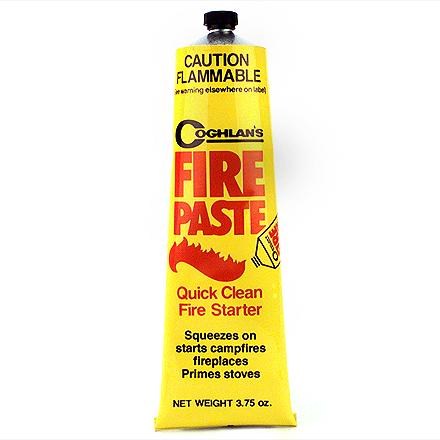
The two above need to be ordered on line, but the ones below are available at your local sporting goods store. I've used the tinder on the left which works pretty well, it's pretty much a cotton material with a thick coating of a petroleum based wax. The Fire Paste is used by a lot of FX guys when starting fire. I haven't used it because the tube always seems too big and bulky to carry in a 72 Hour Bag but you could always use rope or twine and soak it with the fire paste then carry the small sections to use as tinder. Being inventive is a necessity when it comes to adding things to your bag - you have to know what will work for you.
Remember, when you gain ignition you must feed the tinder bundle with oxygen by blowing or fanning the flame gently and as it grows you can begin to add fuel and more oxygen. If you add one or the other too soon you will loose your flame. It's a delicate balance and you need to take it slowly.